
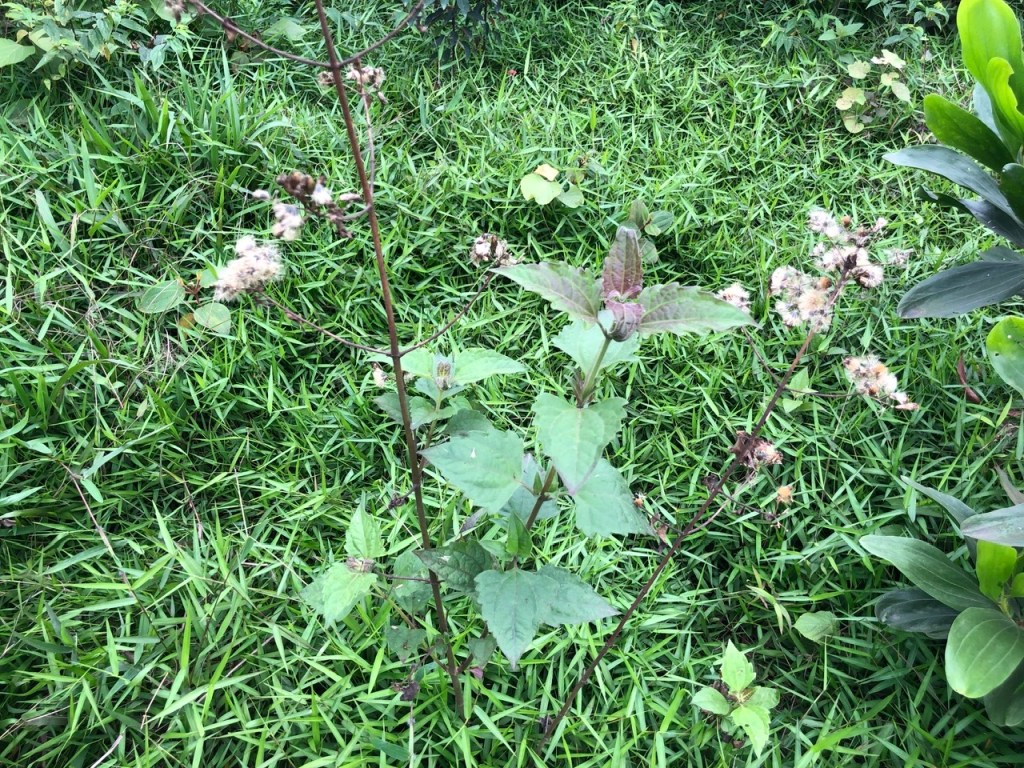
The Journey to Find Chromolaena odorata on Mountain Slopes
Some journeys begin with challenges, guided only by a simple belief — that somewhere in nature, there exist humble plants carrying extraordinary healing power. For me, the journey to search for Chromolaena odorata samples was one of those meaningful adventures.
In the early days, my team and I traveled along winding dirt roads leading deep into the northern mountains of Vietnam. In some places, we had to walk for several kilometers through forest trails to reach areas where Chromolaena odorata grows naturally. Sometimes we climbed slippery slopes or carefully avoided thick thorny bushes along the way. There were moments when the rain suddenly poured down, turning the path muddy and heavy beneath our feet. Yet strangely, no one felt tired — because every time we discovered a healthy Chromolaena plant with tiny purple blossoms shining amid the greenery, an indescribable joy filled my heart.
Few can truly understand the happiness of finding a perfect specimen: sturdy stems, thick aromatic leaves, and thriving in the harshest soil. Each plant was marked and recorded carefully — altitude, soil type, and sunlight direction — before being gently collected and wrapped for transport.
Bringing the plants back to the lowlands was another challenge. Many samples wilted along the journey; some seemed beyond saving, yet with proper care, they revived and grew vigorously in the germplasm garden. Each time I saw them turn green again, I felt as though nature itself was responding to our dedication.
Those journeys taught me that science often begins with the most ordinary things — with muddy hands, patient footsteps on mountain trails, and a sincere belief that if we work with heart, even a small wild plant can bring great value to people’s lives.

Chromolaena odorata – The Cinderella of Science
In Vietnam, Chromolaena odorata is a plant almost everyone has seen — growing along roadsides, on hillsides, or in abandoned fields. People often call it a “weed,” a wild plant known only for growing fast and being hard to eradicate. Yet few realize that beneath its simple, unassuming leaves lies a treasure of valuable bioactive compounds — with proven antibacterial, anti-inflammatory, and wound-healing properties documented in scientific studies around the world.
I often tell my students: “If the world of plants were a fairy tale, then Chromolaena odorata would be Cinderella.”
She’s not the dazzling beauty that draws attention, but the humble girl with hidden strength — waiting for someone patient and curious enough to see her true worth. And our role as scientists is to help that Cinderella step into the light.
I believe scientific research is not only about grand theories or complex laboratory experiments. Sometimes, its true meaning comes from simply recognizing the value in what others overlook.
That is how I hope to inspire my students. When they come to the germplasm garden, observing each Chromolaena plant — noting the color of its leaves, its fragrance, or working with extracts in the lab — they begin to feel the joy of discovery. The joy of realizing that this so-called “weed” could one day become a valuable source of natural medicine, cosmetics, or even a safe alternative to antibiotics in livestock farming.
I see in their eyes a spark of curiosity — that pure, powerful energy science always needs. One student once told me:
“I never thought a plant that grows everywhere could be such an interesting topic for research.”
And in that moment, I knew a small seed had been planted — a seed of belief in science, in the richness of Vietnam’s natural world, and in the potential of young minds to explore it.
The journey of researching Chromolaena odorata is still long, with many mysteries yet to uncover. But I truly believe that with more young hands and hearts involved, this plant will no longer be seen as a mere weed. It will take its rightful place as a valuable medicinal resource of Vietnam, contributing to human health and sustainable agriculture.
And perhaps, along the way, other “Cinderellas” of the plant kingdom will also awaken — each telling us new stories about nature, science, and the quiet power of faith.

Traditional Healing Uses of Chromolaena odorata
For many people in rural Vietnam, Chromolaena odorata is a familiar sight — growing along paths, rice fields, and abandoned lands. To some, it’s just a weed that should be cleared away. But for generations past, this humble plant has been known as a “household remedy” — a simple yet remarkably effective traditional medicine.
Long before modern medicine became widely available, local people discovered that Chromolaena odorata leaves could stop bleeding and heal wounds. Whenever someone got a cut, scrape, or small injury, they would pick a few fresh leaves, wash them, crush them, and apply them directly to the wound. The bleeding would stop almost instantly, swelling reduced, and the skin healed quickly. Because of this property, the plant was nicknamed “the bleeding stopper” and was widely used by soldiers and villagers, especially in mountainous regions or during wartime.
Beyond its wound-healing ability, decoctions or fresh leaf extracts were also used to wash burns, ulcers, or inflamed skin. In some regions, people dried the young leaves and brewed them into tea to support digestion and relieve stomach pain — thanks to the plant’s natural antibacterial and anti-inflammatory properties.
In Central Vietnam, women traditionally used boiled Chromolaena odorata water for postpartum bathing, which helped cleanse, disinfect, and rejuvenate the body after childbirth.
Today, scientific research has confirmed that these traditional practices are well-founded. The plant contains high levels of phenolics, flavonoids, and tannins, which exhibit powerful antibacterial, anti-inflammatory, and antioxidant effects. These compounds promote tissue regeneration and prevent infection. Several studies have shown that extracts from Chromolaena odorata can inhibit harmful bacteria such as Staphylococcus aureus, E. coli, and Pseudomonas aeruginosa — pathogens responsible for skin, digestive, and wound infections.
Interestingly, despite its healing potential, Chromolaena odorata is still often overlooked because of its wild nature and abundance. Yet this simplicity is what makes it so special — a gift from nature that is easy to find, easy to use, safe, and environmentally friendly.
Looking at these traditional insights through the lens of modern science, we can truly appreciate how ancient wisdom and nature have always been in harmony. Perhaps it’s time we stopped calling Chromolaena odorata a weed, and started recognizing it as a valuable medicinal resource — one that deserves greater respect, study, and preservation.


Traditional Use of Chromolaena odorata in Animal Health Care
In many rural areas of Vietnam, when livestock fall ill, farmers don’t always have easy access to veterinary medicine. Instead, they rely on traditional knowledge — simple, time-tested remedies passed down through generations. Among these, one of the most trusted and familiar plants is Chromolaena odorata, known locally as cỏ Lào.
For generations, farmers have known that the leaves of Chromolaena odorata possess strong antibacterial and wound-healing properties. When buffaloes, cows, pigs, chickens, or dogs get small cuts or infections, people often pick fresh leaves, crush them, and apply the paste directly to the wound. Within a few days, the injury dries and heals with minimal swelling or infection. Some even mix the crushed leaves with a little salt to enhance the disinfectant effect — a practical technique widely used by farmers in the midland and mountainous regions.
Beyond treating wounds, decoctions of Chromolaena odorata have been used to clean animal shelters or mix with drinking water to prevent intestinal diseases. Farmers believe the herbal water reduces odor, naturally kills bacteria, and improves animal health. In certain regions of Central Vietnam and the Central Highlands, people also add small amounts of dried leaf powder to poultry feed to prevent digestive disorders and strengthen natural immunity.
Older farmers recall that, back in the days when veterinary antibiotics were scarce, Chromolaena odorata was their “lifesaving medicine.” It was never written in any medical handbook, yet it was always present in the home garden — easy to find, easy to use, and remarkably safe. These traditional practices reflect not only the wisdom of rural communities but also the deep harmony between humans, animals, and nature.
Today, as antibiotic overuse in livestock farming has become a global concern, these age-old experiences are regaining importance. Researchers and agricultural enterprises are now re-examining natural herbs like Chromolaena odorata to develop biological and herbal antimicrobial products as sustainable alternatives to synthetic antibiotics.
From simple folk practices, we can see that nature has always offered ways to keep both humans and animals healthy — as long as we learn to respect and understand it. Once considered a mere weed, Chromolaena odorata is now being rediscovered as a valuable medicinal plant, not only for human healthcare but also for animal well-being — offering a sustainable and promising path for the future of agriculture.